6 unconventional Thanksgiving dishes
Last updated October 8, 2026
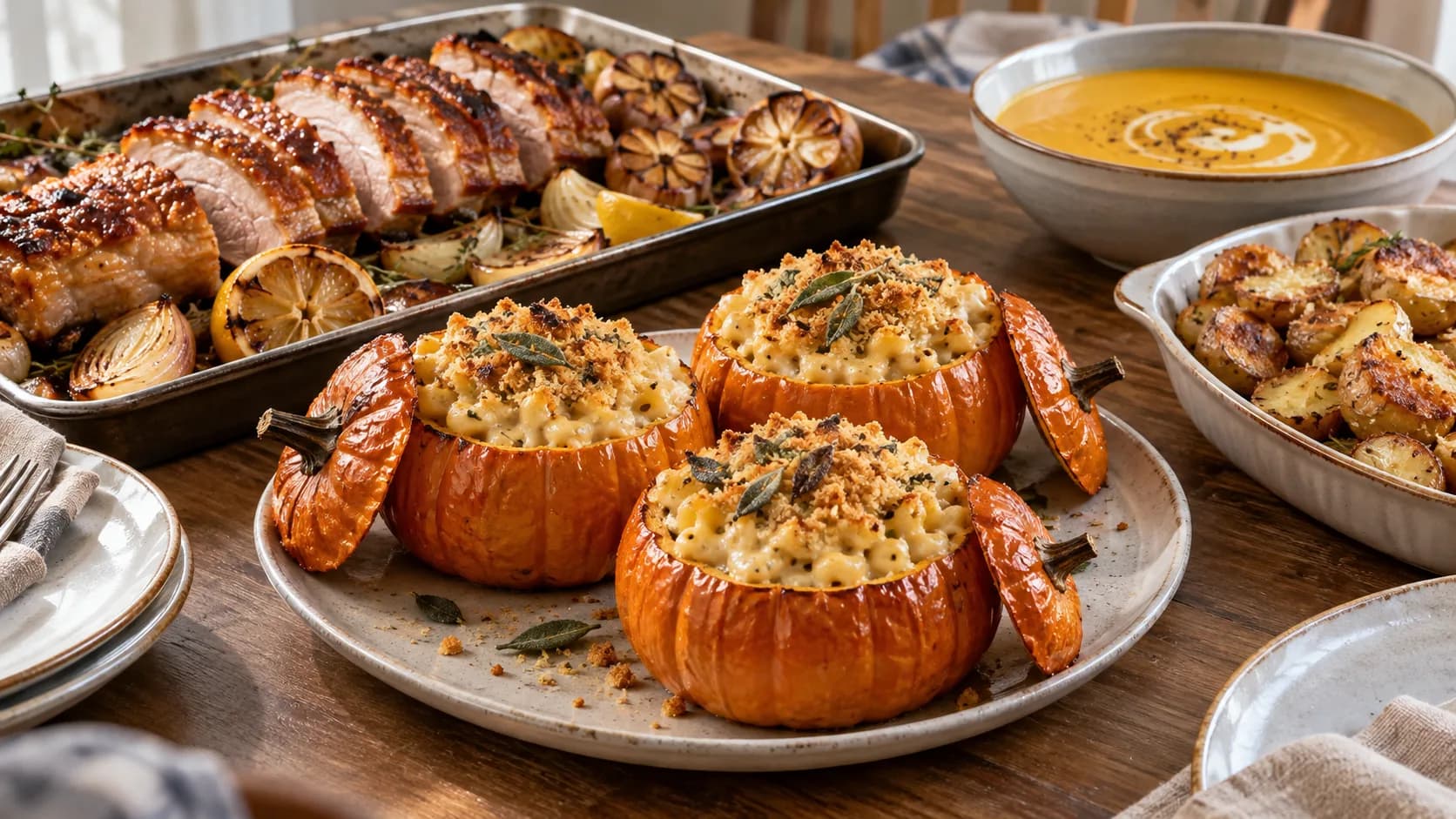
A Thanksgiving table runs on slots: something big in the middle, potatoes, something orange, something green, and a first course while people find their seats. You can keep those slots and change what goes in them. Thanksgiving falls on 26 November in 2026, and the first dish below, a pork belly that wants a half-day marinade, is the one to plan around if you choose it.
Each dish fills one slot. Between them they need an oven, a hob and a blender, plus baking trays and pans. Where a recipe leaves something out, such as a quantity or an oven temperature, the section says so.
The plan at a glance
| Slot | Dish | What it needs from you |
|---|---|---|
| Centrepiece | Lemon roast pork | Marinate about half a day ahead; 50 minutes in the oven plus a 10-minute rest |
| Alternative centrepiece | Spatchcock chicken with herb potatoes | Spatchcocking; 40 to 50 minutes in the oven plus a 15-minute rest |
| Potato side | Cheesy potsticker roast potatoes | Oven time; the recipe gives no temperature |
| Pumpkin side | Baked mini pumpkin mac and cheese | 10 to 12 mini pumpkins; 15 minutes at 400°F, then 15 to 20 at 375°F once filled |
| Starter | Roasted butternut squash and carrot soup | 40 minutes of roasting, then blend |
| Veg | Sichuan fish-fragrant aubergine claypot | Hob only; listed at 20 minutes |
Choose one centrepiece rather than both. The two meats call for different oven settings (375°F for the pork, 425°F for the chicken) and each wants the oven for the better part of an hour.
Centrepiece: lemon roast pork
Pork belly goes into a bag with shio koji, honey, grated garlic, lemon slices and rosemary, and stays in the fridge for about half a day. The recipe's editor notes say the soak matters because shio koji's enzymes need hours to tenderise and season the pork, so this is the dish to start the day before or early on the morning itself.
On the day, take the pork out 30 minutes to an hour before cooking, lightly scrape off the marinade and set it on a tray of onion, halved garlic bulbs and lemon slices. It roasts at 190°C (375°F) on the lower rack for 25 minutes a side, 50 minutes in all, and rests for 10 minutes off the heat. Meanwhile, the recipe has you heat the saved marinade with whole-grain mustard, lemon juice, honey, olive oil and soy sauce in a small pan until slightly thickened, which gives you a pan sauce by the time the pork is sliced.
The recipe is written for 4 using a 1 kg block of pork belly. For a bigger table, its editor notes say doubling needs two trays: two bellies and their vegetables on one tray steam instead of roasting. That means two trays' worth of oven space, which is worth counting before you commit to the rest of the menu.
Alternative centrepiece: spatchcock chicken
If you would rather roast a whole chicken than a belly of pork, this recipe puts a spatchcocked bird and cubed Yukon gold potatoes on one sheet pan. You cut out the spine, press the bird flat, pat it dry, salt it on both sides, season the meat under the breast skin, and put it straight on the pan with no parchment. The potatoes are tossed in oil with salt and pepper and arranged around it, with a handful of thyme tucked under the bird and the rest of the herbs wedged among the potatoes. The oven goes to 425°F, and the recipe gives 40 to 50 minutes uncovered and a 15-minute rest before carving.
The recipe does not list servings or a total time, and it gives a doneness figure that this guide does not repeat, because the recipe's own note points to the USDA minimum for poultry. Use a thermometer and the FSIS chart linked above. For a closer look at why drying the skin and leaving the bird uncovered matter, see how to get crispy roast chicken skin.
Potato side: cheesy potsticker roast potatoes
Halved baby potatoes are tossed in oil and seasoning, then set cut-side down on a layer of melted butter mixed with finely grated Parmesan. In the oven the cheese underneath crisps into a crust that stays stuck to the cut face, and you lift the potatoes out cut-side up with the crust attached. A little more Parmesan goes over the potatoes before they roast, and a little more as a garnish.
This is the least specified recipe in the set: no quantities, no oven temperature and no roasting time, only roasting until the potatoes are golden. The listed 2 servings and 45 minutes are estimates, so cook it once before the day and note the temperature that works in your oven. To feed a table, use a bigger dish or two, so the potatoes still sit cut-side down on the cheese. If you choose the chicken, the potatoes already on its pan make this dish a second potato rather than a replacement.
Pumpkin side: baked mini pumpkin mac and cheese
For the orange slot, this recipe uses the pumpkin itself as the dish: 10 to 12 mini pumpkins, each hollowed out and filled with a pumpkin-sauce macaroni cheese. You cut a lid off each one, scoop out the seeds, brush them inside and out with olive oil, season the insides, and bake them and their lids cut-side down at 400°F (200°C) for 15 minutes. The walls should still feel firm at that point.
Next, the pasta is boiled for 2 minutes less than the packet says. The sauce is a butter-and-flour base loosened with warm whole milk and whipping cream, then canned pumpkin purée, Dijon, garlic powder, pepper and salt, and finally cheddar, Gruyère and Parmesan stirred in off the heat. The recipe says not to return it to the heat, or the sauce may separate, and to keep it looser than a normal macaroni cheese because the pasta goes on absorbing it in the oven. The pasta is spooned loosely into the pumpkins, topped with panko toasted in butter with Parmesan and chopped sage, and baked at 375°F (190°C) for 15 to 20 minutes. It is done when the sauce bubbles at the edges, the crumbs are golden and a knife slides easily through the pumpkin walls. Rest it 5 minutes before serving with the lids leaned against each pumpkin.
It lists 11 servings and 65 minutes, the only servings figure above 4 in this set (the chicken and aubergine recipes list none). The trade-off is space: the pumpkins go on two large baking sheets. Its second bake is at 375°F, the same setting as the pork, so the two may be able to share an oven, but the recipes do not say whether the trays and timings fit together.
Starter: roasted butternut squash and carrot soup
A halved butternut squash goes cut-side up on a tray with chopped onion, carrot, halved tomatoes, a whole head of garlic and a knob of ginger, drizzled with olive oil and roasted for 40 minutes until soft and caramelised. The flesh and vegetables, plus the garlic squeezed from its skins, go into a blender with water or vegetable stock and are blended smooth. Coconut cream, chilli flakes and sliced green onion are optional toppings, and with coconut cream rather than dairy cream the soup is plant-based.
It lists 4 servings and 55 minutes. The roasting temperature is not stated, and the quantities are estimates read from the video, so taste and adjust the liquid for thickness, which the recipe does tell you to do. It needs the oven for 40 minutes, so it competes with whatever else needs the oven that day.
Veg: Sichuan fish-fragrant aubergine claypot
This dish never touches the oven. Wedges of aubergine are browned in a large flat pan over medium-low heat in batches, then lifted out. In the same pan you fry garlic, ginger and the white of the spring onions, then minced pork and diced salted fish, then Guilin-style chilli sauce. The aubergine returns with dark soy, then a mixed sauce of water, light soy, oyster sauce, sugar, salt and cornstarch, simmered until it coats everything. It goes into a pot to serve, because the recipe says it is best straight from the pot.
It is listed at 20 minutes. Two things to know before you plan it. Salted fish is the ingredient the recipe calls its soul, so find it in advance, though the creator says your own favourite chilli sauce can stand in for the Guilin one. And it contains minced pork, which matters if the pork belly is also on the table. Because it uses the hob, it can be cooked while the oven is full. For other ways to cook the same vegetable, see what to cook with aubergines.
Sequencing the day
The recipes only support a rough order, because several give no oven temperature.
- The day before or early that morning: start the pork marinade, if you are cooking the pork.
- Before roasting: if you are cooking the pork, take it out of the fridge 30 minutes to an hour beforehand.
- Oven: the squash soup needs 40 minutes, the mini pumpkins 15 minutes empty and 15 to 20 filled, the pork 50 plus a 10-minute rest, the chicken 40 to 50 plus a 15-minute rest. The potatoes have no stated time. The soup, the meat and the potatoes can only share an oven if you find a temperature that suits all of them, which is why a trial run of the potatoes is worth it.
- During the meat's rest: the pork's sauce is made alongside the roast and rest, and the chicken's 15-minute rest is a window to finish the potatoes or the aubergine.
- On the hob: the aubergine needs no oven at all, and the macaroni cheese is made on the hob after the empty pumpkins go in; the recipe does not time it against their 15-minute bake. The aubergine is best cooked last, since it is served hot from its pot.