What are macros, and what does a % actually tell you?
Last updated September 24, 2026
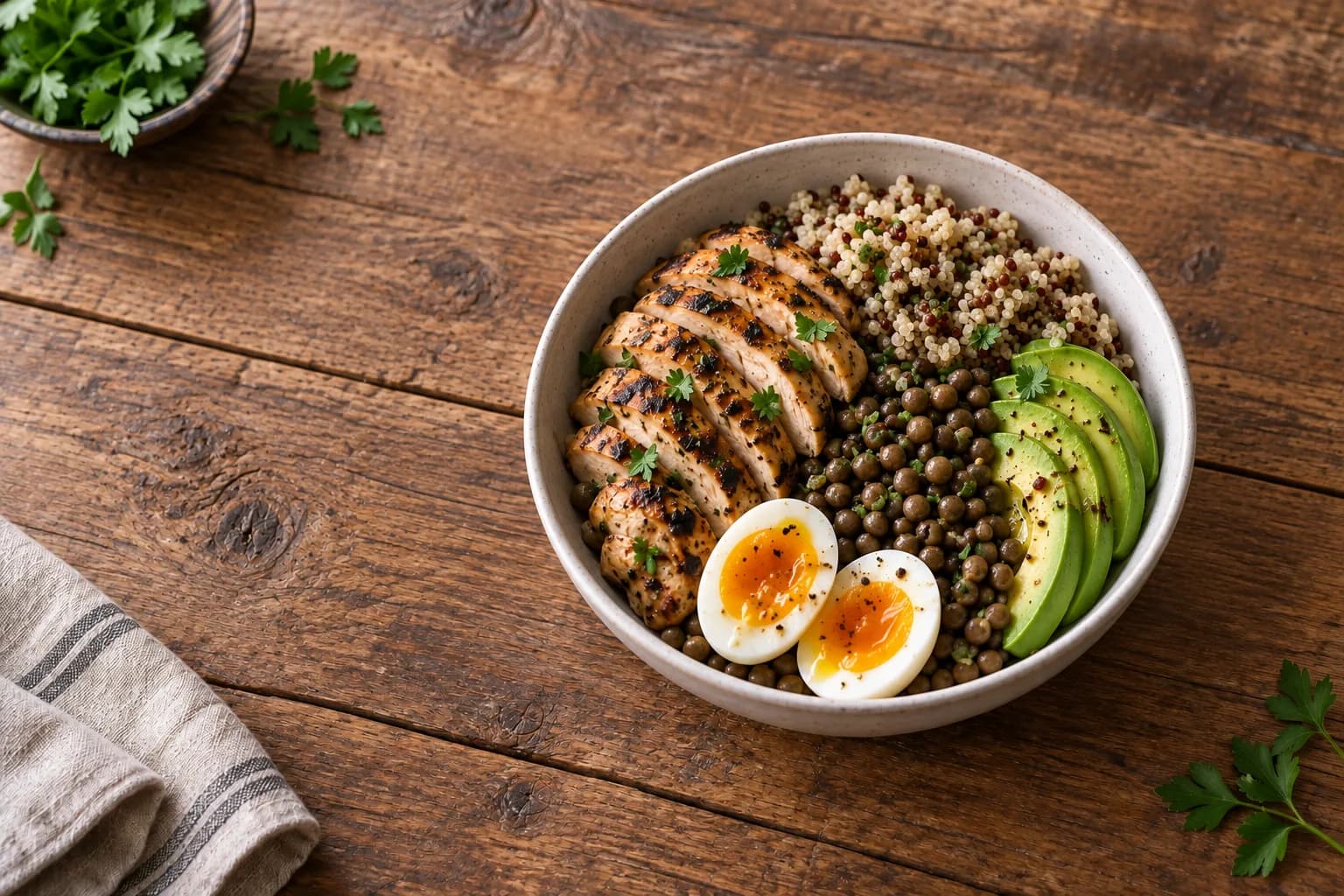
A macro percentage tells you the balance of a dish — how its energy splits between protein, carbohydrate and fat. It does not tell you how much you are eating. Two dishes can share an identical split and still differ hugely in portion size and total calories, which is the single thing worth taking from this article if nothing else sticks.
What are the three macros?
They are the three nutrients that supply the body with energy and the materials to grow and repair itself: protein, carbohydrate and fat. Every dish you cook is some mixture of the three, plus water, fibre, vitamins and minerals that don't count toward "macros" at all.
Each does a different job. Protein is "essential for the body to grow and repair itself," the NHS explains — it's why egg, chicken and lentils turn up in a lot of main courses. Carbohydrate is the body's default fuel: the NHS describes starchy foods as "a good source of energy and the main source of a range of nutrients in our diet." Fat does two jobs at once — it carries fat-soluble vitamins A, D and E, which "can only be absorbed with the help of fats," and it supplies essential fatty acids the body cannot make on its own, per the NHS. None of the three is the "bad" one; a dish being high in one doesn't mean it's short on merit.
Why does the same dish read as different percentages in different apps?
Because a macro percentage is usually a share of energy, not a share of weight, and those give genuinely different numbers for the same plate of food. This is the most common source of confusion once someone starts comparing apps or labels.
Fat, gram for gram, carries far more energy than protein or carbohydrate. The NHS puts a number on it: "a gram of fat, whether it's saturated or unsaturated, provides 9kcal (37kJ) of energy compared with 4kcal (17kJ) for carbohydrate and protein" — figures known as the Atwater factors, confirmed in the same terms by the British Nutrition Foundation: "fats are a major and concentrated source of dietary energy, providing 9kcal of energy per gram, compared with 4kcal per gram for carbohydrates and for proteins." A small amount of fat by weight can therefore account for a large share of a dish's energy — and therefore a large share of its "macro %" — even in a dish that's mostly vegetables and grain by mass.
Take a simple stir-fry: chicken, vegetables and rice, finished with two tablespoons of oil.
| Measured by | Protein | Carbohydrate | Fat |
|---|---|---|---|
| Weight (grams of each macro) | large share | largest share | smallest share |
| Energy (kcal contributed) | about a third | about a third | about a third, from far fewer grams |
Nothing about the dish changed between the two rows — only the ruler. If an app shows its split by energy rather than by weight, that is why a dish that's mostly vegetables and grain can still show up as "high fat": the oil is a small fraction of the plate's weight but a large fraction of its calories.
Does a higher protein percentage mean a dish has more protein?
Not necessarily — it can just mean the dish has less of something else, or a smaller portion. Because the three shares always add up to 100%, one percentage can only be read next to the other two, and none of the three tells you an absolute amount on its own.
A small, protein-forward snack and a large, carbohydrate-heavy dinner can carry the same grams of protein while showing completely different percentages, simply because the dinner has more carbohydrate diluting the share. The reverse also holds: a tiny, oil-slicked side dish can post a striking fat percentage while contributing barely any fat in absolute terms, because the whole portion is small. A percentage describes proportion within one dish; it says nothing about how that dish compares to another, or to what you actually need in a day.
So what should you actually look at instead?
Look at where the nutrients in a dish come from, and treat the percentage as a description of balance rather than a verdict on the food. A recipe built around lentils and oats is telling you something real about where its carbohydrate and plant protein originate; a recipe finished with avocado is telling you where its fat comes from. That's a more useful, checkable fact than a single number stripped of context.
Portion size and total energy matter more than any split. A generous bowl of a "high-carb" dish and a small bowl of a "high-protein" one can land at the same calories, or wildly different ones — the percentage alone can't tell you which. If you're trying to understand a meal, start with what's actually in it and how much of it you're serving, then treat the macro split as one more piece of context, not the headline.
Nourishible doesn't display a macro percentage on any recipe today. Most recipes here are extracted from videos that don't state ingredient quantities precisely enough to compute one honestly, and a confident-looking number built on a guess is worse than no number at all. What you can already do is look at the ingredients themselves — every ingredient page here states what a food actually contains, sourced and per 100g, without asserting a total for any specific dish.
The short version
A macro percentage is a ratio between protein, carbohydrate and fat within one dish — never a quantity, and never a verdict on the dish. Most apps calculate it by energy rather than weight, using the same 4/4/9 kcal-per-gram figures the NHS and the British Nutrition Foundation both quote, which is why an oil-finished vegetable dish can read as "high fat" despite being mostly vegetables by weight. When you want to understand a meal, look at what it's made from and how much of it you're eating — that tells you more than any single percentage can.