Starting baby-led weaning: the first few weeks
Last updated October 7, 2026
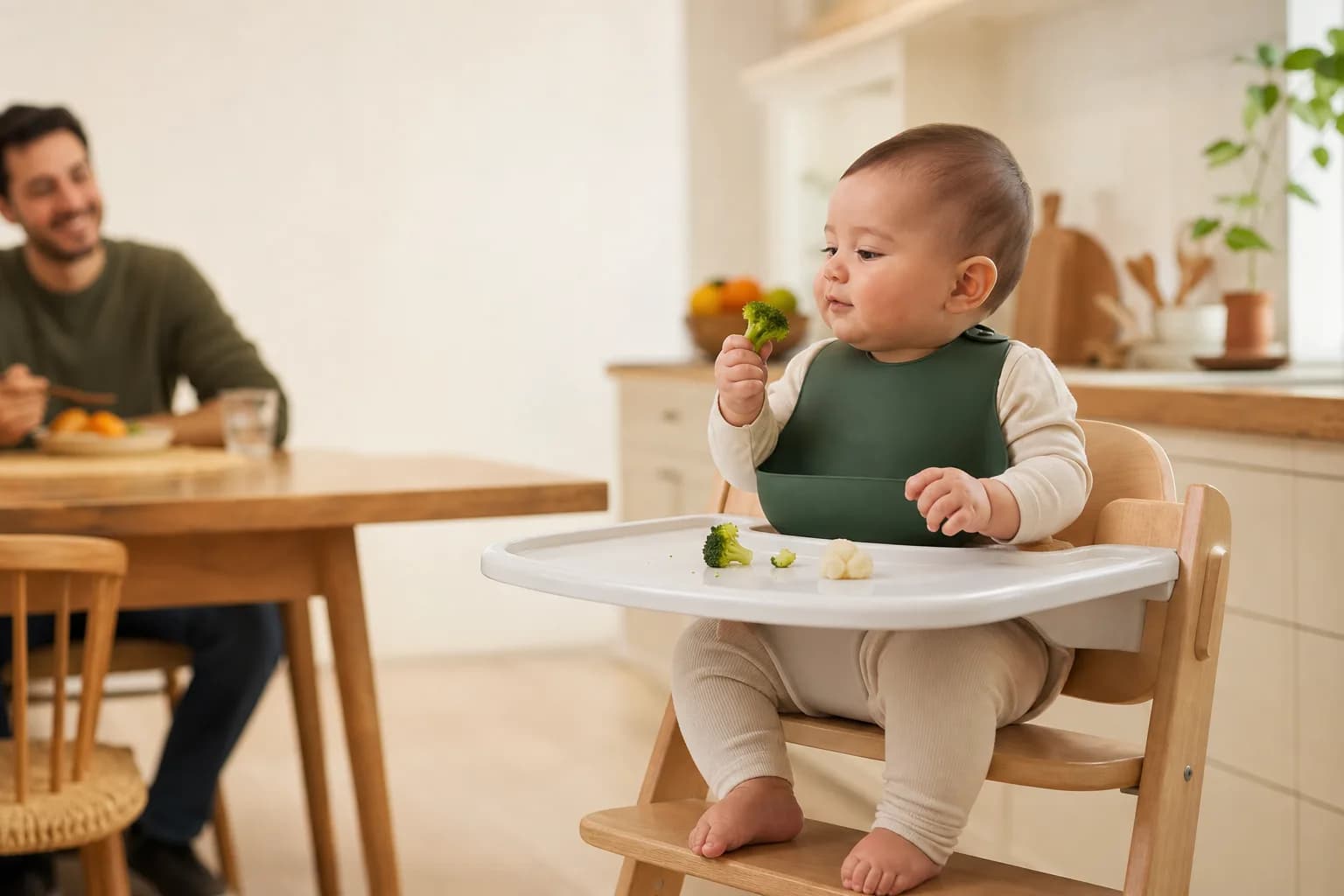
For the first few weeks your baby is learning to handle food rather than eating it, and milk is still doing the feeding. Wait for the readiness signs, offer one small meal a day, and expect very little of it to be eaten.
How do you know your baby is ready?
The NHS lists three signs, and a baby who can only sit up is not there yet.
- They can "stay in a sitting position and hold their head steady".
- They can "coordinate their eyes, hands and mouth, so they look at food, pick it up and put it in their mouth".
- They can "swallow food rather than spit it back out".
The NHS adds that chewing fists, wanting extra milk feeds and waking in the night are normal baby behaviours, and not necessarily a sign that your baby is ready.
These usually turn up around six months, which is when the NHS advises starting solids: "breast milk or first infant formula provides the energy and nutrients needed until around 6 months". If your baby looks ready well before six months, talk to your health visitor first. If the signs have not all arrived, a short wait is normal. If your baby is past six months and still is not there, mention it to your health visitor rather than waiting on.
If your baby was born prematurely, the NHS says to ask your health visitor or GP when to start weaning. Preterm babies are usually counted by corrected age, their age from the due date. A leaflet from Cambridge University Hospitals NHS Foundation Trust gives "four to six months corrected age" as when babies may be ready, and says iron supplements for preterm babies are prescribed by the GP, so do not start or stop one without asking. Your neonatal team or health visitor can work out the timing for your baby.
What should you offer first, and how often?
Start with vegetables that are not so sweet. The NHS gives broccoli, cauliflower and spinach as examples, and suggests "a small amount of solid food, once a day, at a time that suits you both". Cook broccoli and cauliflower until soft. Milk is still your baby's main source of nutrition: the NHS says "your baby's main source of nutrition is still breast milk or first infant formula".
The simplest way to cook for a baby and the family together is to take your baby's portion out before you add salt. The NHS says babies "do not need salt or sugar added to their food (or cooking water)".
For which specific foods to start with, each with its nutrition and the rules that apply, see the first foods index. Iron has its own guide, and the NHS lists iron-containing foods to include from the start. Vitamin D has one too.
What do the first few weeks look like?
Expect very little to be eaten at first, with milk still doing most of the feeding. A food refused several times may be accepted later: the NHS says "it may take 10 tries or more for your baby to get used to new foods, flavours and textures". Offering it again without pressure is fine. Over the first weeks, meals gradually become more like meals around milk feeds, though every baby's timetable is different.
How much should they eat?
It depends on your baby's appetite. The NHS says to "let your baby guide you on how much food they need" and never to force them to eat. If you are worried about how little they are eating or about their weight, ask your health visitor.
What should you do at the table?
- Check the shape before anything goes on the tray. The NHS says to cut food "into narrow batons" and to avoid round shapes and firm foods, and suggests "soft, cooked sticks" of vegetables and fruit. The safety guide has the shapes to avoid.
- Put the food down and let your baby pick it up. Loading a piece and handing it over is fine; putting it in their mouth is not.
- For wet foods such as yoghurt, porridge or hummus, you can load a spoon and hold it out handle-first for them to take. That is a practical variation on finger foods.
- Gagging is a normal reflex as your baby learns to chew and swallow, according to the NHS. The safety guide explains how it differs from choking.
- Always supervise your baby while they eat, as the NHS says. Eat at the same table, so you are with them without staring.
- Stop when they are done. Turning away, batting your hand aside, sealing their lips or dropping food over the side all mean the meal is over, even if barely anything went in. Take the food away. The NHS says never to force a baby to eat.
What do you need to buy?
Very little, and you can start with what is already in your kitchen.
- A highchair with the harness fastened, so your baby sits upright. The NHS says to use "a securely fitted safety harness in a high chair" and never to leave babies unattended on raised surfaces.
- A wipeable mat under the chair, which cuts the cleanup most.
- Bibs with sleeves, more than you think.
Special bowls, spoons, moulds and pouches are optional, and they mostly solve problems you do not have yet.
When should you ask someone?
Call 999 and get medical help immediately if, after a food, your baby has a severe allergic reaction (anaphylaxis). The NHS describes it as a medical emergency. Signs include:
- swelling of the throat or tongue
- difficulty breathing
- blue, grey or pale skin
- being limp, floppy or not responding like they normally do
The NHS lists other signs of a food allergy, including swollen lips and throat, an itchy rash, vomiting, a cough and wheezing. If your baby has any of these after a food, tell your GP or health visitor. Choking on the food itself is also an emergency and looks different; the safety guide covers how to tell.
For anything else that worries you, such as a baby who is not gaining weight, is refusing most food, or has symptoms after a food that are not an emergency, speak to your GP or health visitor. They know your baby and this page does not.
Before the first meal, read the safety guide, which explains how gagging differs from choking.