Baby-led weaning vs spoon feeding: what the evidence says
Last updated October 1, 2026
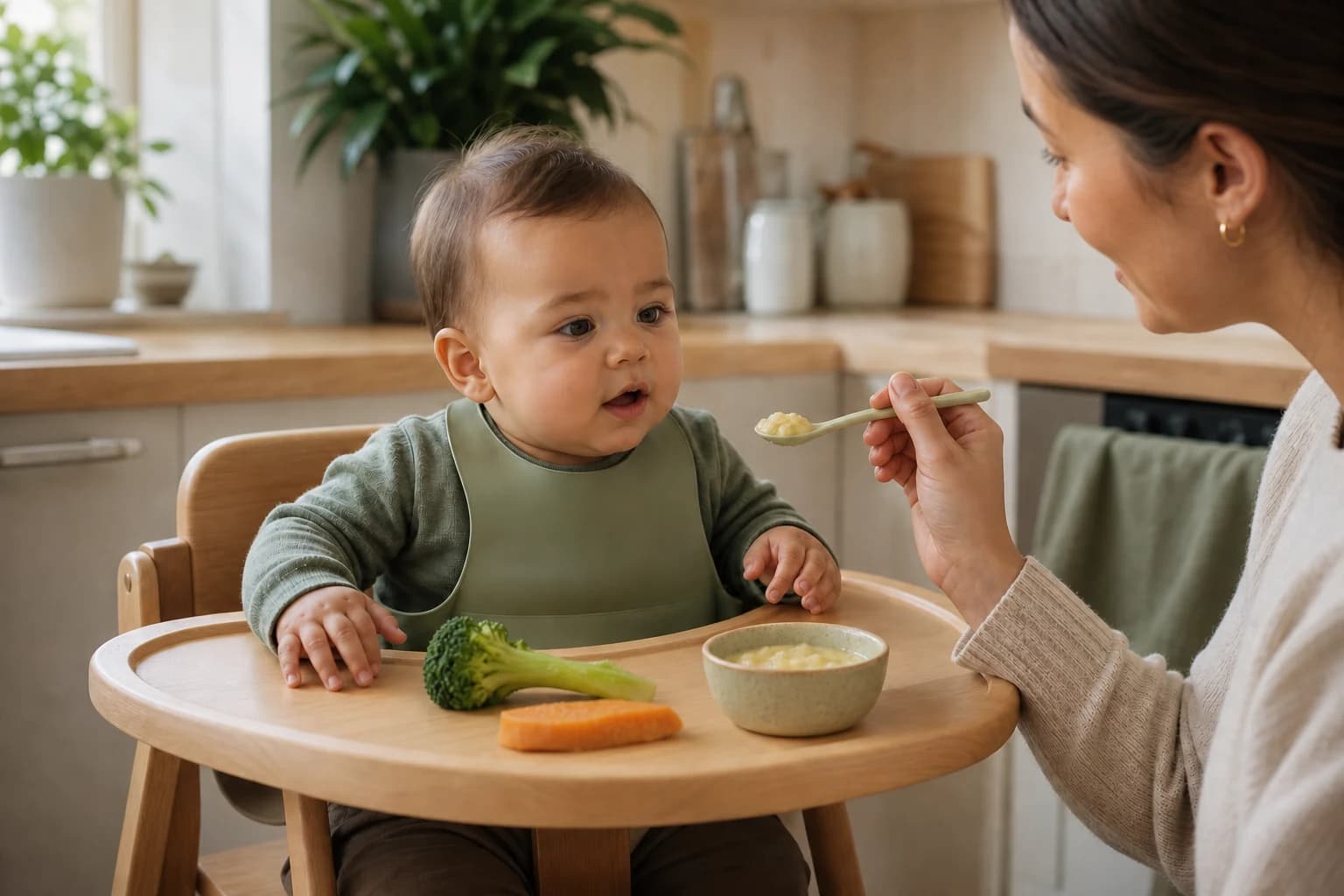
The randomised trials compared baby-led weaning with spoon-feeding on choking, iron status and growth. What they tested was a supported, modified version of baby-led weaning, not the version most families do, and about a third of babies in one trial choked at least once whichever group they were in.
You do not have to choose one. In a survey SACN cites, only around a third of mothers who said they did baby-led weaning stuck to it fully; most also offered some spoon-feeding.
What is the actual difference between the two methods?
Who holds the food. The NHS ("Your baby's first solid foods") defines baby-led weaning as "giving your baby only finger foods and letting them feed themselves from the start instead of feeding them puréed or mashed food on a spoon." Spoon-feeding is the reverse: a parent loads purée or mash and feeds it to the baby.
The NHS also says that "it may take 10 tries or more for your baby to get used to new foods, flavours and textures", and that you should "let your baby guide you on how much food they need", never forcing them to eat.
What was actually tested?
Not baby-led weaning as most families do it. The baby-led arm in three of the four trials was BLISS, a modified, supported version.
BLISS gave families structured advice designed to minimise choking and iron deficiency, across eight additional visits from before birth to nine months. That is a programme, not a philosophy you can decide to follow at home. So the findings below are evidence for the supported version, at least for the BLISS trials. Baby-led weaning without that coaching has not been shown to be equivalent, because it has not been the thing tested.
The review that gathered the trials (Márquez-Díaz et al., Nutrition Reviews, published 13 January 2026) is a systematic review of four randomised controlled trials covering 898 infants. Its literature search ran from September 2022 to March 2023, so the evidence is older than the publication date. Three of the four trials come from the same New Zealand research group (the BLISS trial) and one from Turkey.
What do the trials say about choking?
In the 2016 trial below, about a third of babies choked at least once, whichever group they were in. The trials found no significant difference between the groups, which does not mean either method is low-risk.
In a 2016 trial of 206 infants (Fangupo et al., Pediatrics), 35% choked at least once between 6 and 8 months, with no significant difference between the BLISS group and the usual-care group at any time point. Gagging did differ: more at 6 months in the BLISS group, less at 8 months.
The authors' own caution is worth keeping. A large number of children in both groups were offered foods that pose a choking risk, and the study authors call this concerning.
Gagging and choking are different things, and mixing them up is the commonest confusion here. The safety guide explains how to tell them apart and how to cut food whichever method you use.
Does one method give a baby more iron?
Not in the trials, though the baby-led babies in them were getting structured iron coaching.
The 2026 review found no significant difference in iron intake, ferritin or haemoglobin between groups, and the BLISS iron trial found the same at 12 months (Daniels et al., BMJ Open, 2018). The trials show that baby-led weaning with iron coaching can match spoon-feeding on iron. They do not show that the method alone determines it.
Early self-fed portions are small, so what a baby manages to eat is worth choosing deliberately. Iron-rich first foods covers what carries iron and how to serve it as a finger food.
Do baby-led babies end up leaner or less fussy?
The evidence is thinnest here.
On growth, the trials disagree with each other. One, from Turkey, reported less overweight in the baby-led group. The BLISS trial found no difference in BMI z-score at 12 or 24 months (Taylor et al., 2017, as summarised by SACN). SACN adds that because follow-up stopped at 24 months, "an effect on obesity later in childhood cannot be entirely ruled out".
On fussiness, the BLISS trial reported less food fussiness than in the spoon-fed comparison group. SACN notes that 65% of BLISS parents deferred complementary feeding to six months, against 18% in the control arm, which may have affected that result. It is one trial's finding, from the same supported programme, and not a settled fact.
The wider claim that baby-led weaning produces leaner or less fussy children comes mostly from observational studies, which cannot establish cause. SACN notes they are open to confounding and reverse causation: in one, parents may have turned to spoon-feeding because the baby was already heavier or more demanding.
How firm is the 2026 review?
Its authors conclude that baby-led weaning "does not increase choking risk or compromise iron status compared with" spoon-feeding. That rests on a small, closely related set of trials, and it is not a settled verdict. The review does not say how its findings apply to every baby, and this page has not checked who the trials enrolled.
Do you have to choose one?
No. As the survey above suggests, many families mix the two, and the trials do not tell you which to pick. Iron, texture and cutting are covered in iron-rich first foods and the safety guide. To decide where to begin, see what baby-led weaning is and starting baby-led weaning.